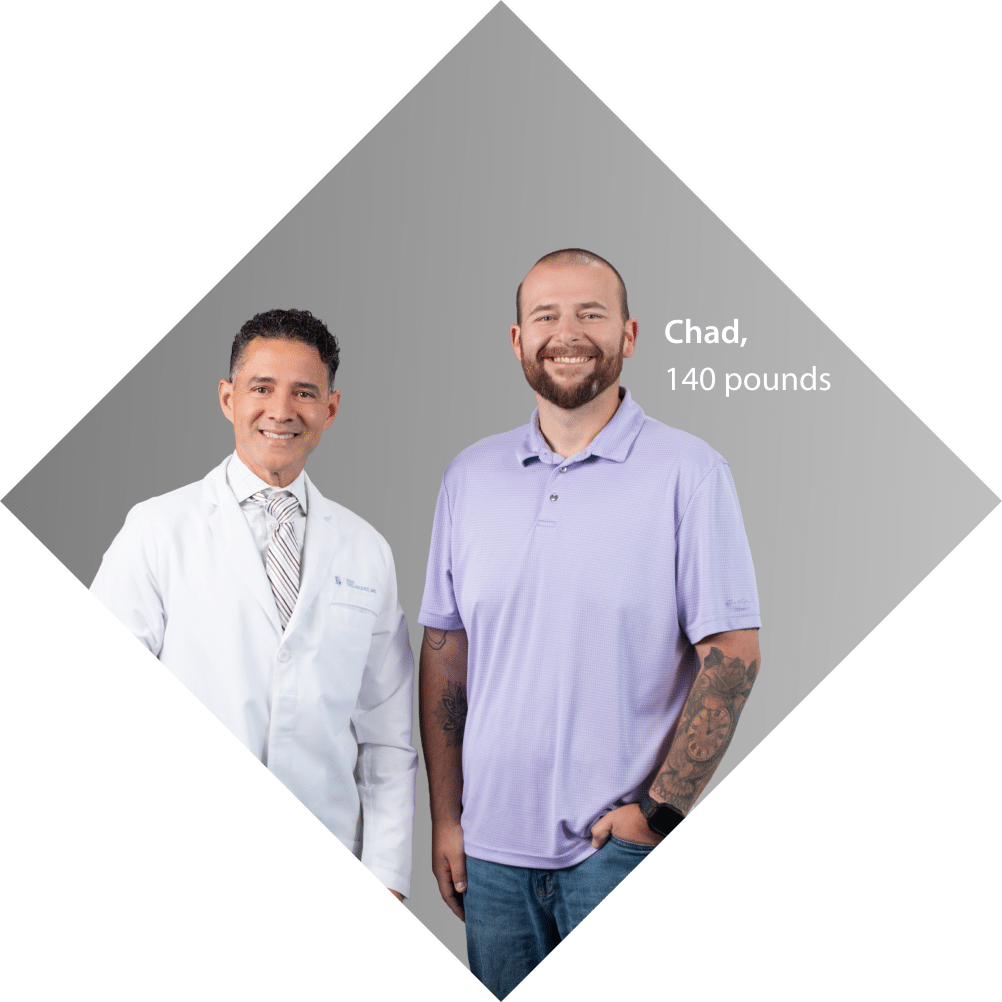
A few years ago, the surgeons at Longstreet Clinic Center for Weight Management began offering a bariatric procedure that combined elements of longstanding and trusted weight loss surgeries in a new approach that produced eye-opening results.
Known as the SADI (Single Anastomosis Duodenal-Ileal Bypass with Sleeve Gastrectomy), the procedure builds on the success of the sleeve gastrectomy (gastric sleeve) while providing an additional mechanism for long-term weight management. The early returns promised a significant advance in bariatrics – one that surgeons hoped would represent an ideal option for patients who met certain criteria.
For Center for Weight Management patients like Chad Kersh, that hope has turned into a successful reality – and stories like Chad’s are why the SADI weight loss surgery is now a common route to lasting health for patients in northeast Georgia.
When he chose to undergo the SADI at the Center for Weight Management, Chad weighed over 350 pounds and spent much of his home life on the couch, struggling just to play with his children. And while Chad had to fit certain criteria to qualify for the procedure, as well as make some lifetime changes to his diet, he is more than happy with his decision, his care providers, and the procedure itself.
“I was nervous at first. But once I met the Center for Weight Management staff, I felt like it was like an extension of my family and that, no matter what, they had my back,” Chad said. “I knew about some of the other procedures. But the SADI is more for patients that are maybe a little bit bigger.”
During a SADI, surgeons at the Center for Weight Management perform a minimally invasive operation that reduces a patient’s stomach size by roughly 80 percent and bypasses a portion of their small intestine. The results turn the stomach into a narrow tube. The new, smaller stomach restricts food intake and alters hunger hormones, helping patients to feel full longer. By also detaching the upper part of the patient’s small intestine (duodenum) and reconnecting it to a lower loop of the intestine, surgeons ensure that the patient’s body also absorbs fewer calories.
“The SADI combines the (gastric) sleeve with a metabolic bypass component, resulting in greater and more durable weight loss as well as improved outcomes for obesity-related conditions such as type 2 diabetes,” said Center for Weight Management surgeon and director Dr. Robert Richard, MD, FACS, FASMBS. “The SADI is a less aggressive variant of the traditional Biliopancreatic Diversion with Duodenal Switch (DS). The DS being a duodenal-ileal bypass with two anastomoses. The main advantage of the bypass in both operations is the addition of significant malabsorption.”
Chad is walking proof of the SADI’s effectiveness.
Six months following the procedure, Chad weighed just 208 pounds and was able to keep up with his kids and then some, beginning a regular workout routine and umpiring travel ball games.
That doesn’t necessarily mean the SADI is the right choice for every patient in need of bariatric help, but it does make it a viable and effective option for many patients.
“Not all patients who qualify for a sleeve are necessarily ideal candidates for a SADI. The procedure is often considered for patients with higher Body Mass Indexes, those with significant metabolic disease such as type 2 diabetes, or patients seeking greater weight-loss potential than a sleeve alone may provide,” Dr. Richard said.
That’s why providers at the Center for Weight Management – such as Dr. Richard and Dr. Eric Velazquez, MD, MBA, FACS, FASMBS – spend plenty of time getting to know their patients, so that they can make the best decision based on the most information available.
“Patient selection is individualized and depends on medical history, goals, and overall risk assessment,” Dr. Richard said, noting that SADI patients must also stick to a strict post-operation diet. “That’s why we continue to offer a range of bariatric operations, and the best procedure is determined through a personalized evaluation of each patient’s needs and health conditions.”
After performing numerous SADI surgeries at the Center for Weight Management, which has offices in Gainesville, Braselton, and Suwanee, Longstreet providers consider it a most useful tool that can produce significant and lasting results. Yet it is just one of many approaches that the clinic utilizes, and providers work hard to help patients select the route that promises the most success over the long term.
“Our bariatric surgeons have collectively performed hundreds of SADI procedures,” Dr. Richard said. “We do offer the full traditional Duodenal Switch procedure as well. However, the SADI has become a well-established and commonly performed operation within our practice, particularly as long-term data continues to demonstrate favorable outcomes for weight loss and metabolic improvement. “
If you would like to learn more about the SADI or any of Longstreet Clinic’s approaches to lasting weight loss, please contact the Center for Weight Management at 770-534-0110 or visit our website.